Oracle Fusion Cloud PaaS Extensions: A Pragmatic Approach to Custom Development
Why Standard Oracle Functionality Should Always Come First, and When Custom Development Makes Sense
The adoption of Oracle Fusion Cloud represents a significant step in enterprise application modernization. With extensive standard functionality, configurable business processes and continuously evolving capabilities, Oracle Fusion Cloud provides organizations with a comprehensive platform for managing their financial, operational, supply chain and human resource requirements.
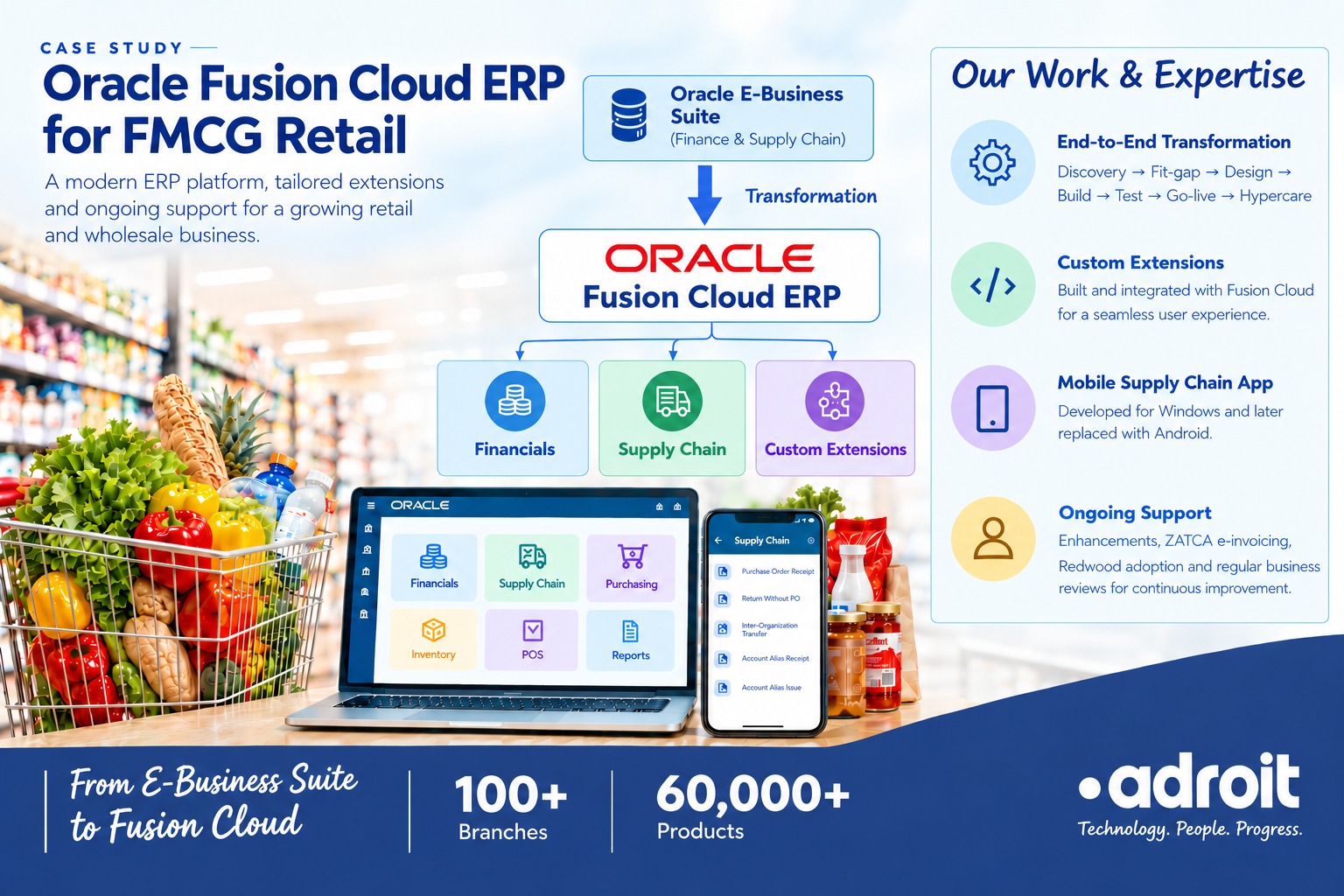
However, organizations transitioning from legacy ERP environments such as Oracle E-Business Suite often encounter a familiar challenge: certain business processes have evolved over many years and may involve highly specialized requirements that are not adequately addressed by standard Oracle Fusion Cloud functionality.
The natural temptation is to replicate existing customizations in the new cloud environment.
At Adroit Systems, we believe this should not be the default approach.
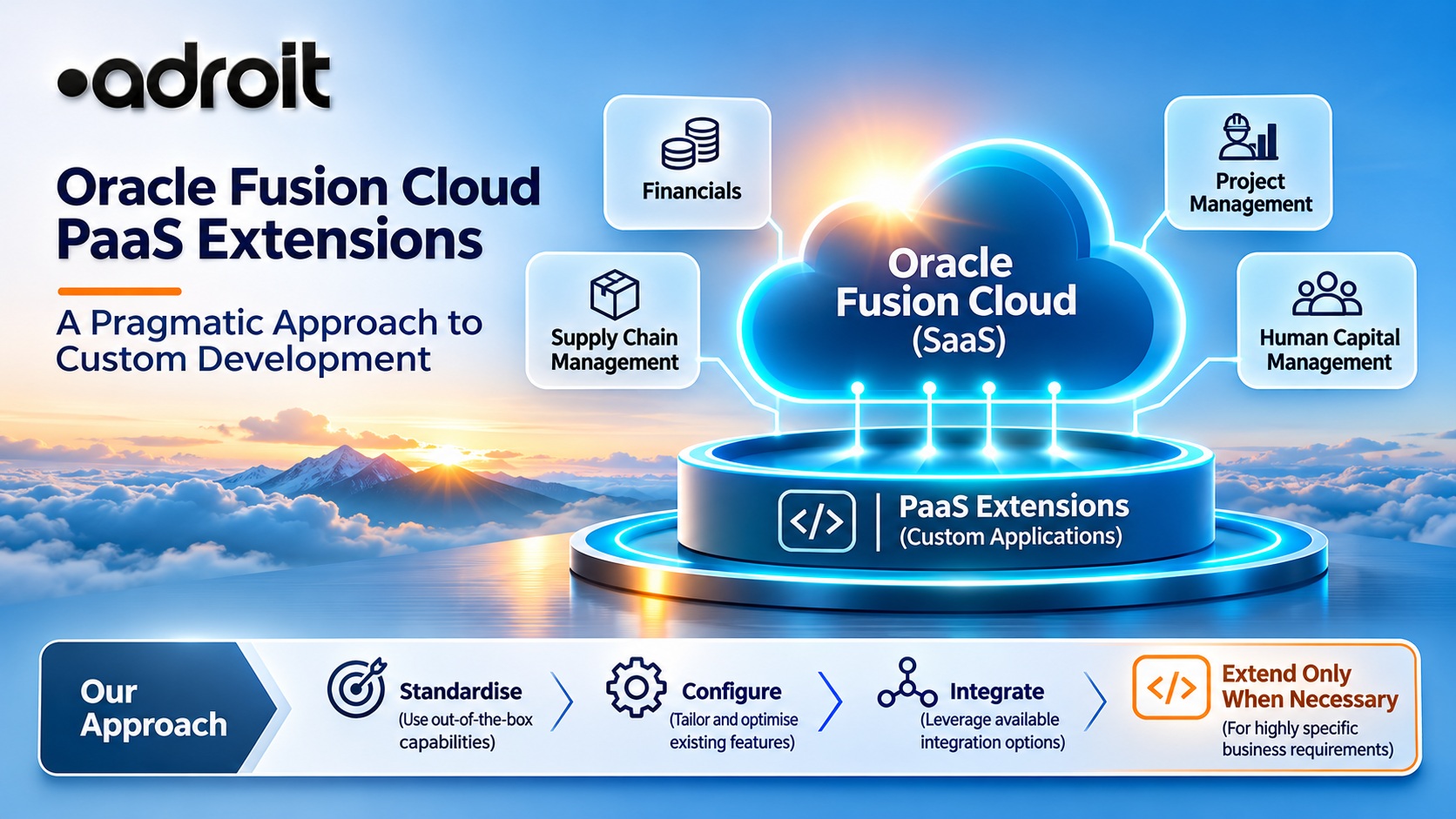
Our philosophy is straightforward: Leverage standard Oracle Fusion Cloud functionality wherever possible and consider custom development only when there is a compelling business justification.
1. Standard Oracle Functionality Should Be the First Choice
Oracle Fusion Cloud offers extensive application capabilities across Financials, Supply Chain Management, Procurement, Project Management and Human Capital Management.
Before considering any custom development, organizations should thoroughly evaluate:
- Existing standard Oracle functionality.
- Application configuration and personalization options.
- Available business rules and approval workflows.
- Functional extensions and supported integration capabilities.
- Oracle Marketplace and available third-party solutions.
- Opportunities to simplify or redesign existing business processes.
In many instances, what initially appears to be a missing functionality requirement can be addressed through appropriate application configuration or business process realignment.
Organizations should also be willing to reconsider legacy business processes rather than automatically reproducing every historical customization.
This approach reduces implementation complexity and helps preserve the benefits of adopting a standard cloud ERP platform.
2. Why We Do Not Recommend Unnecessary Customizations
Custom development introduces additional responsibilities throughout the application lifecycle.
Although a custom solution may address an immediate business requirement, it can introduce additional considerations involving:
Maintenance and Support: Custom applications require ongoing maintenance, documentation, monitoring and technical support.
Upgrade Compatibility: Oracle Fusion Cloud evolves continuously. Custom extensions and integrations must be designed and maintained to remain compatible with supported Oracle interfaces and platform changes.
Integration Complexity: Custom applications introduce additional integration points, dependencies and potential failure scenarios that need to be managed.
Security and Governance: Custom-developed applications require appropriate authentication, authorization, data access controls and security reviews.
Total Cost of Ownership: The initial development cost is only one component. Organizations must also account for ongoing maintenance, enhancements, testing and future platform changes.
For these reasons, Adroit Systems does not advocate customization as a routine solution to every business requirement.
We recommend it only when standard functionality, configuration options, process improvements and available integration alternatives cannot adequately address a genuinely specific business need.
3. When Does Custom PaaS Development Make Sense?
There are situations where standard functionality may not fully accommodate an organization's operational requirements.
Examples include:
- Highly specialized sales order processing requirements
- Industry-specific transaction management
- Custom Point of Sale integration and consolidation
- Specialized time and attendance applications
- Unique pricing and promotional processes
- Business-specific interfaces and operational workflows
In such scenarios, custom PaaS development can provide a practical way to extend the capabilities of Oracle Fusion Cloud without unnecessarily modifying its core SaaS applications.
The decision should always be driven by business necessity, architectural suitability and long-term maintainability.
4. Oracle PaaS: Extending Oracle Fusion Cloud
Oracle Platform as a Service (PaaS) provides capabilities for developing and integrating additional applications alongside Oracle Fusion Cloud SaaS.
Rather than modifying the underlying Oracle SaaS application, custom functionality can be developed as a separate extension using appropriate Oracle Cloud technologies and supported integration mechanisms.
Depending on the requirement and current Oracle platform capabilities, these solutions may involve:
- Custom application development
- Oracle-supported APIs and web services
- Business process extensions
- External application integration
- Custom user interfaces
- Data exchange and transaction processing
A properly designed extension should operate within an appropriately governed architecture, respecting Oracle's security, integration and extensibility guidelines.
The objective is to address the specific business requirement while keeping the core Oracle SaaS environment as standard as reasonably possible.
5. Adroit Systems' SaaS-PaaS Integration Approach
Adroit Systems follows a structured approach to extending Oracle Fusion Cloud through custom PaaS applications.
Our SaaS-PaaS integration approach focuses on developing specialized business functionality as separate extensions and integrating these with the core Oracle Fusion Cloud environment.
The objective is to provide users with a cohesive application experience while maintaining a clear architectural separation between standard SaaS functionality and custom-developed extensions.
Our experience includes developing extensions for requirements such as:
- Custom Sales Order processing
- Quick Sales applications
- Time and Attendance interfaces
- Purchasing-related functionality
- Point of Sale consolidation
- Retail Promotions and Pricing
These solutions demonstrate how specialized business requirements can be accommodated without turning the core Oracle Fusion Cloud application into an unnecessarily customized ERP environment.
6. Our Recommended Decision Framework
At Adroit Systems, we believe every proposed customization should undergo a structured evaluation before development is considered.
Our recommended sequence is:
Step 1: Understand the Business Requirement: Establish the actual business problem rather than immediately accepting the requested technical solution.
Step 2: Evaluate Standard Oracle Functionality: Determine whether existing Oracle Fusion Cloud capabilities can satisfy the requirement.
Step 3: Explore Configuration and Process Alternatives: Assess whether configuration, workflow changes or business process realignment can achieve the desired outcome.
Step 4: Evaluate Available Integration Options: Consider supported APIs, third-party applications and existing Oracle Cloud capabilities.
Step 5: Justify Custom Development: Only when the alternatives are inadequate should a custom PaaS extension be considered.
Step 6: Design for Long-Term Maintainability: Ensure the proposed extension follows supported architecture, security, integration and governance practices.
7. Our Philosophy: Extend Only When Necessary
The real value of Oracle Fusion Cloud lies in its standardized, continuously evolving application capabilities.
Custom development should complement these capabilities, not undermine the benefits of adopting a cloud ERP platform.
At Adroit Systems, we believe that the best solution is not necessarily the one involving the most development. It is the one that addresses the business requirement effectively while keeping the overall enterprise application architecture as simple, maintainable and sustainable as possible.
Our approach is therefore to adopt standard Oracle functionality wherever practical and introduce custom PaaS extensions only when highly specific business requirements genuinely justify them.
Standardize where possible. Configure where appropriate. Integrate where necessary. Customize only when there is no practical alternative.
This is how we approach Oracle Fusion Cloud implementations and enterprise application extensions, with a focus on long-term business value rather than unnecessary technical complexity.