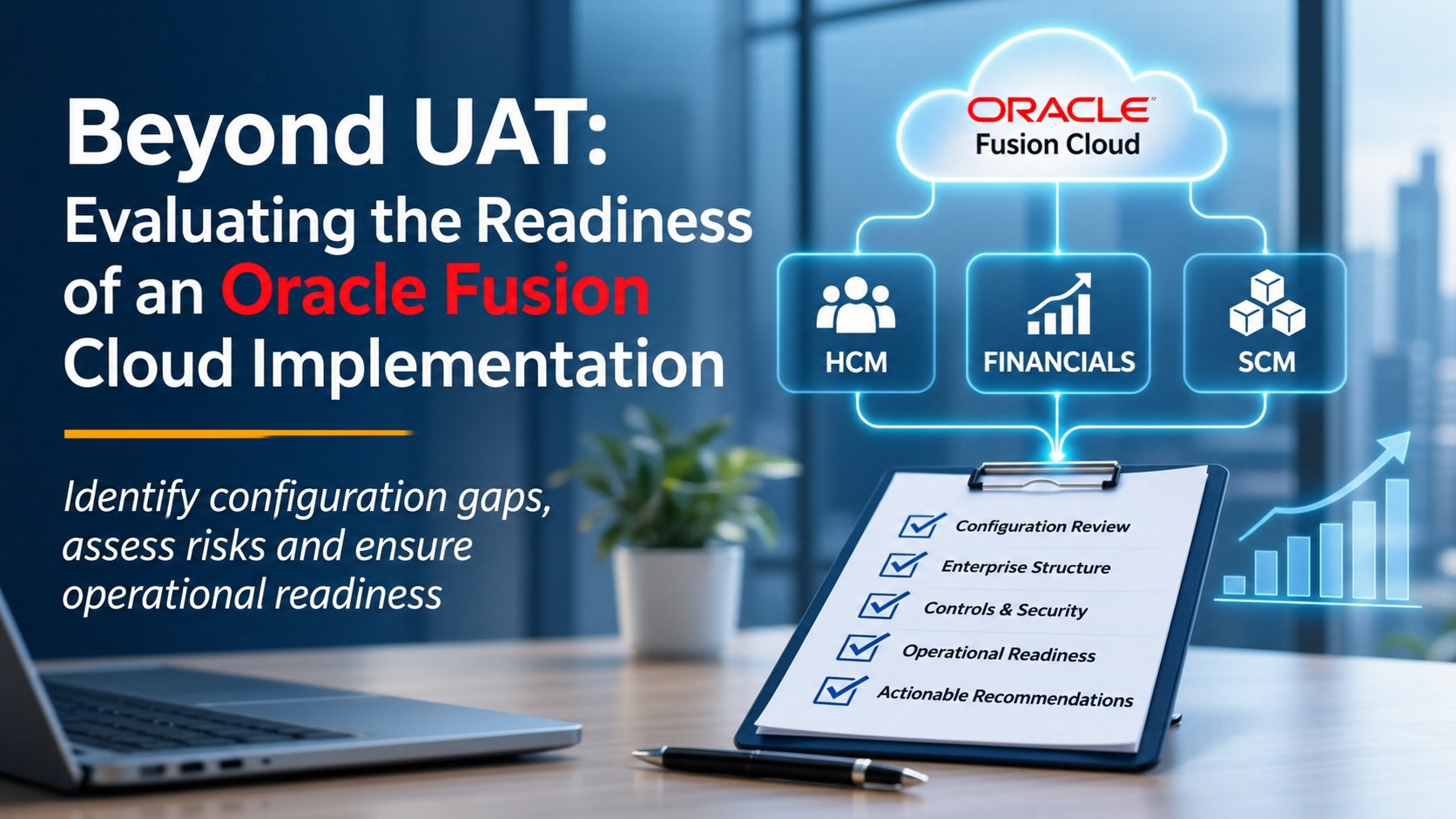
Beyond UAT: Evaluating the Readiness of an Oracle Fusion Cloud Implementation
Completing User Acceptance Testing (UAT) is an important milestone in any ERP implementation. It gives business users an opportunity to validate system functionality, test business processes and confirm whether the solution meets their operational requirements.
However, successful UAT does not necessarily mean that every underlying configuration, structural decision and control has been optimally designed.
An Oracle Fusion Cloud environment can perform its intended functions while still containing configuration gaps, design inconsistencies or areas that may require attention as the organization grows and its business requirements evolve.
This is where an independent implementation assessment can provide additional perspective.
An Independent Perspective on Oracle Fusion Cloud
Adroit Systems was invited by an organization to conduct an independent assessment of its Oracle Fusion Cloud implementation following the completion of User Acceptance Testing.
The assessment covered three key functional areas: Oracle Financials, Human Capital Management (HCM) and Supply Chain Management (SCM).
Our objective was to review important aspects of the solution, including enterprise structures, functional configurations, data structures and system controls, and identify areas where refinements or additional considerations could help strengthen the overall implementation.
The exercise highlighted several important aspects of Oracle Fusion Cloud implementation design.
1. Financial Architecture: Getting the Foundations Right
Financial architecture is one of the most important considerations in an ERP implementation. Decisions concerning the enterprise structure, ledger configuration and Chart of Accounts influence financial processing, reporting, controls and the organization's ability to accommodate future business changes.
Our assessment examined several areas, including:
Ledger and Business Unit Structure
The choice between single and multiple ledger structures should reflect the organization's legal, financial and operational requirements. Considerations include accounting calendar control, reporting requirements, transaction processing, intercompany accounting and data security.
Similarly, Business Unit structures should be aligned with the organization's procurement, payables, receivables and operational responsibilities.
Chart of Accounts Design
The Chart of Accounts is more than a collection of accounting segments. Its structure influences financial reporting, transaction processing, management analysis and future flexibility.
Key considerations include segment definitions, segment qualifiers, value set design, naming conventions, intercompany accounting and the use of appropriate validation controls.
For example, the absence of suitable segment security and cross-validation rules can increase the possibility of inappropriate account combinations or inconsistent transaction coding.
The length and complexity of account combinations also deserve attention, as they can influence usability, reporting and integration requirements.
Fixed Assets Configuration
Asset-related structures require similar consideration. Asset categories, locations and flexfields should support the organization's asset classification, tracking and reporting requirements.
System control parameters, including the oldest date placed in service and asset numbering, should also be reviewed in the context of historical asset data and opening balance migration requirements.
These decisions are particularly important when preparing to migrate existing asset records into the new environment.
2. HCM: Payroll Accuracy and Workforce Data Integrity
Oracle Fusion Cloud HCM configuration has implications that extend beyond the HR department. Payroll calculations, employee entitlements and costing information can directly affect financial accounting and employee administration.
The assessment identified several areas requiring attention.
Payroll and Absence Configuration
Absence types that affect payroll need appropriate element associations. Gaps in these relationships can result in incorrect earnings or deductions and may require retrospective payroll adjustments.
Vacation plans and accrual configurations also need to account for different employee scenarios, including mid-month hires, employee transfers and changes in employment grade.
Payroll Costing and Accruals
Department costing should be sufficiently defined to support accurate payroll accounting.
Accrual configurations for benefits such as vacation provisions, air tickets and end-of-service benefits also require alignment between HR policies and Finance expectations.
Where employee grade changes or promotions occur during a payroll period, the treatment of related accruals and entitlements should be clearly established.
Workforce Information and Controls
Employee records need to capture the information required for operational, reporting and regulatory purposes.
The assessment also considered employee numbering, dependent information, payroll access controls and user provisioning.
These areas illustrate why HCM configuration should be reviewed not only from a functional perspective, but also in terms of data completeness, compliance requirements and the accuracy of downstream processes.
3. SCM: Aligning Inventory Structures with Actual Operations
Supply Chain Management configurations should reflect how an organization physically manages, stores and moves its inventory.
An enterprise structure that appears logically organized within the application may introduce unnecessary complexity if it does not correspond with actual warehouse operations and responsibilities.
Our review considered several important design elements.
Inventory Organization Structure
Organizations should evaluate whether separate Inventory Organizations are genuinely required or whether operations can be managed within a simpler structure.
Factors such as physical warehouse separation, inventory ownership, operational responsibility and transaction control should influence this decision.
Creating multiple organizations without a corresponding operational requirement can introduce additional complexity in item assignments, purchasing, receiving and inventory transfers.
Subinventory Design
Subinventories should reflect meaningful operational or control requirements.
Where multiple subinventories are maintained without distinct ownership or operational responsibilities, consolidating them may provide a simpler and more manageable structure.
The objective is not necessarily to minimize the number of subinventories, but to ensure that the structure serves a clear business purpose.
Item Categories and Numbering
Item categories and numbering conventions play an important role in inventory management, procurement and reporting.
A consistent approach to item classification, including the distinction between capital expenditure (CAPEX) and operating expenditure (OPEX) requirements, can improve data consistency and usability.
Item numbering should also follow a logical and consistent structure that supports identification, querying and reporting without introducing unnecessary complexity.
4. Configuration, Controls and Governance Matter
Beyond individual functional modules, several broader considerations emerged from the assessment.
Consistent Naming Conventions
A standardized naming convention for segments, value sets, lookups and mapping sets helps maintain consistency and simplifies administration.
Data Validation and Security
Appropriate validation rules and security configurations help prevent incorrect data combinations and restrict access to information in accordance with business requirements.
Reporting and Documentation
Custom reporting and document requirements should be evaluated early enough to ensure that the solution supports the organization's operational and management information needs.
Data Migration Planning
Cut-off dates, opening balances and master data migration requirements need careful consideration. Configuration decisions made during implementation can have a direct bearing on the accuracy and completeness of migrated information.
These considerations may appear relatively small when viewed individually. Collectively, however, they contribute to the maintainability, reliability and usability of an ERP environment.
5. Turning Assessment Findings into Actionable Improvements
Identifying configuration gaps is only part of an implementation assessment. Equally important is understanding their potential impact and determining the appropriate corrective action.
Not every observation carries the same level of risk or requires immediate intervention.
Some findings may warrant attention because they could affect payroll accuracy, financial accounting, transaction processing or regulatory compliance. Others may represent opportunities to simplify configurations, improve reporting or enhance the user experience.
A structured assessment should therefore consider:
The underlying business requirement and intended system behaviour.
The potential operational or financial impact of the observation.
Whether the issue requires configuration changes, additional controls or process clarification.
The implications of making changes to an already configured environment.
The appropriate priority and timing for corrective action.
This helps organizations move beyond a list of observations towards a practical improvement plan.
Conclusion: Successful UAT Is a Milestone, Not the Only Measure of Readiness
Oracle Fusion Cloud implementations involve numerous interconnected decisions across enterprise architecture, functional configuration, data structures, security and business processes.
A solution may successfully demonstrate its intended functionality during UAT, while still presenting opportunities to improve its design, controls and long-term maintainability.
An independent assessment provides an additional opportunity to examine these aspects, identify potential risks and make informed recommendations.
At Adroit Systems, we believe that the quality of an ERP implementation should be evaluated not only by whether the system works, but also by how well it is designed to support the organization's business requirements today and as they evolve.
A successful implementation is not simply one that passes testing. It is one that provides a sound foundation for the business to operate, adapt and grow.
About Adroit Systems
Adroit Systems provides Oracle E-Business Suite and Oracle Fusion Cloud consulting services, including implementation, application support, upgrades, technical development and optimization. With extensive experience across enterprise applications in the Middle East, we help organizations strengthen their Oracle environments and derive sustained value from their technology investments.